1. The Torque Converter – replaces your clutch
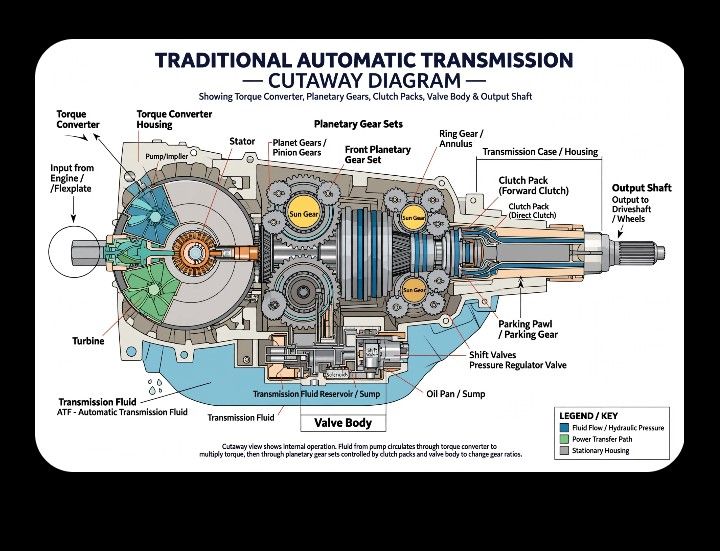
This is the donut-shaped thing bolted to the engine.
Inside it, there’s no solid connection. There are two fans facing each other in oil:
• Pump/Impeller – connected to the engine, flings fluid outward • Turbine – connected to the transmission, gets pushed by that fluid • Stator – in the middle, redirects fluid so you get torque multiplication at low speed
That’s why you can stop at a light in Drive without stalling, and why the car creeps forward when you release the brake. At higher speed, a lock-up clutch locks pump and turbine together so it doesn’t waste energy.
2. The Planetary Gearset – the real magic
Manual transmissions have gears on parallel shafts that you slide in and out. An automatic never disconnects – it has 2-3 planetary sets in series, always meshed.
Each set has:
• Sun gear in the center • Planet gears around it • Ring gear around the outside • Carrier that holds the planets
By holding one part stationary and driving another, you get a different ratio. For example:
• Hold sun, drive ring -> low gear, lots of torque • Lock sun and ring together -> direct 1:1 • Hold ring, drive sun -> overdrive
You don’t move gears. You just decide which part to hold.
3. How it holds parts – clutches and bands
To hold a sun or ring gear, the transmission uses wet multi-plate clutch packs and brake bands. They are squeezed by hydraulic pressure.
The brain for that pressure is the Valve Body at the bottom of your diagram. It’s a maze of valves and solenoids. In old cars it was purely hydraulic. In modern cars the TCU (Transmission Control Unit) watches throttle, speed, engine load, and tells solenoids: “send 150 psi to clutch pack #2”.
Shift = release one clutch pack, apply another. All in 150-300ms.
4. What actually happens when you drive
P: Parking pawl jams into a notched wheel on the output shaft. Mechanical lock.
R: A planetary set reverses direction.
N: All clutch packs released – no connection.
D: The TCU starts in 1st (holds sun gear of first set), as speed rises it sequentially swaps which clutch is held. The oil pump (driven by the engine) supplies all the pressure.
The fluid, ATF (Automatic Transmission Fluid), is doing three jobs at once: transmitting torque in the converter, applying clutches hydraulically, and lubricating/cooling everything.
Why it feels smooth
Because shifts are overlapping clutches, not disconnecting power. And the torque converter absorbs shocks with fluid.
Quick contrast with other “automatics”:
• CVT: no planetary steps, two pulleys + belt sliding infinitely • DCT / Dual-Clutch: actually two manual transmissions with computer-controlled clutches, faster but more jerky at low speed • Traditional automatic (what you asked): torque converter + planetary – smoothest, strongest for big cars.
If you want, tell me the car you have – I can tell you exactly how many planetary sets and gears it uses and when it locks up.


Leave a Reply