Engine sensors are the nervous system of your engine. The engine itself is mechanical, but the ECU – Engine Control Unit – needs to know exactly what’s happening inside it to control fuel, spark, and air. Sensors do that job.
Think of it like this: Sensors measure, ECU decides, actuators act.
Here are the most important ones:
1. Air Measurement Sensors
These tell the ECU how much air is entering the engine, so it can add the right amount of fuel.
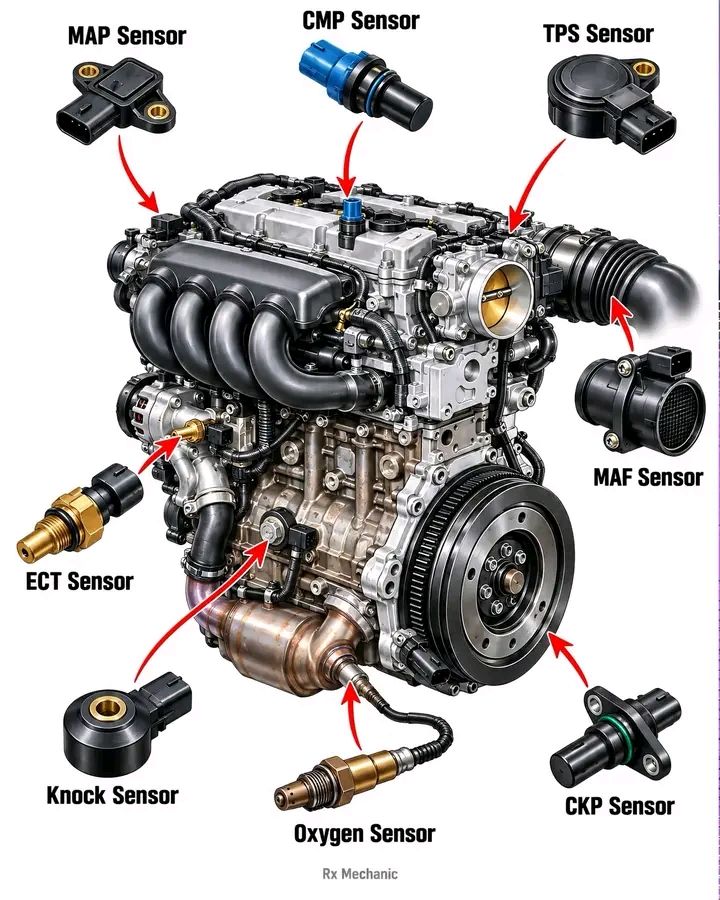
MAF Sensor – Mass Air Flow Sensor
Located just after the air filter. Measures the actual weight of air coming in. If it fails, you’ll get poor mileage, rough idle, and hesitation.
MAP Sensor – Manifold Absolute Pressure Sensor
Measures pressure inside the intake manifold. Used as a backup or alternative to MAF on many engines. Helps calculate engine load.
IAT Sensor – Intake Air Temperature Sensor
Cold air is denser than hot air. This sensor tells the ECU the air temperature so it can adjust fuel.
2. Position and Speed Sensors
These tell the ECU where the engine is in its rotation and how fast it’s spinning.
CKP Sensor – Crankshaft Position Sensor
The most critical sensor. Tells the ECU the exact position and speed of the crankshaft. Without it, the engine won’t start. It controls ignition timing and fuel injection timing.
CMP Sensor – Camshaft Position Sensor
Works with the CKP. Tells the ECU which cylinder is on its compression stroke. Needed for sequential fuel injection and variable valve timing.
TPS – Throttle Position Sensor
On the throttle body. Tells the ECU how far you are pressing the accelerator. Controls throttle response, automatic gear shifts, and idle.
3. Temperature and Pressure Sensors
ECT – Engine Coolant Temperature Sensor
Tells the ECU if the engine is cold or hot. When cold, ECU adds more fuel like a choke. Also controls the cooling fan and temperature gauge.
Oil Pressure Sensor / Switch
Monitors engine oil pressure. If pressure drops, it triggers the oil light. Some engines will reduce power to protect themselves.
Fuel Pressure Sensor
On modern direct-injection engines. Ensures fuel rail pressure is correct.
4. Emissions and Combustion Sensors
O2 Sensor – Oxygen Sensor
Located in the exhaust. Measures how much unburned oxygen is left after combustion. The ECU uses it to constantly adjust the air-fuel mixture to 14.7:1 for best efficiency. Modern cars have 2-4 of them. The upstream one controls fuel, downstream checks if catalytic converter is working.
Knock Sensor
A microphone bolted to the engine block. Listens for engine knock or pinging – premature detonation that can damage the engine. When it hears knock, ECU retards ignition timing.
EGR Position Sensor
Monitors the Exhaust Gas Recirculation valve, which sends some exhaust gas back to reduce emissions.
How they work together 1. You press the accelerator -> TPS says throttle is 50% open 2. MAF/MAP + IAT say “we have this much cool air” 3. CKP/CMP say “engine is at 2500 RPM, cylinder 1 is ready” 4. ECU calculates: inject X milliseconds of fuel, spark at Y degrees 5. Engine fires, O2 sensor checks the result and says “a bit lean, add more fuel next time” 6. Knock sensor says “all quiet, timing is good”
If any sensor sends a wrong signal, the ECU stores a code and turns on the Check Engine Light. That’s what an OBD2 scanner reads – P0113 for IAT, P0335 for crankshaft, P0420 for catalyst/O2, etc.
Common signs of a failing sensor:
• Check engine light • Hard starting, rough idle, stalling • Poor fuel economy • Loss of power, hesitation on acceleration • Black smoke from exhaust
Do you want me to focus on a specific car? Like Toyota, Honda, or diesel engines? The sensor set changes a bit depending on the engine type.


Leave a Reply